
The 2026 NPPF: What’s Changed for Landscape, Ecology and Planning
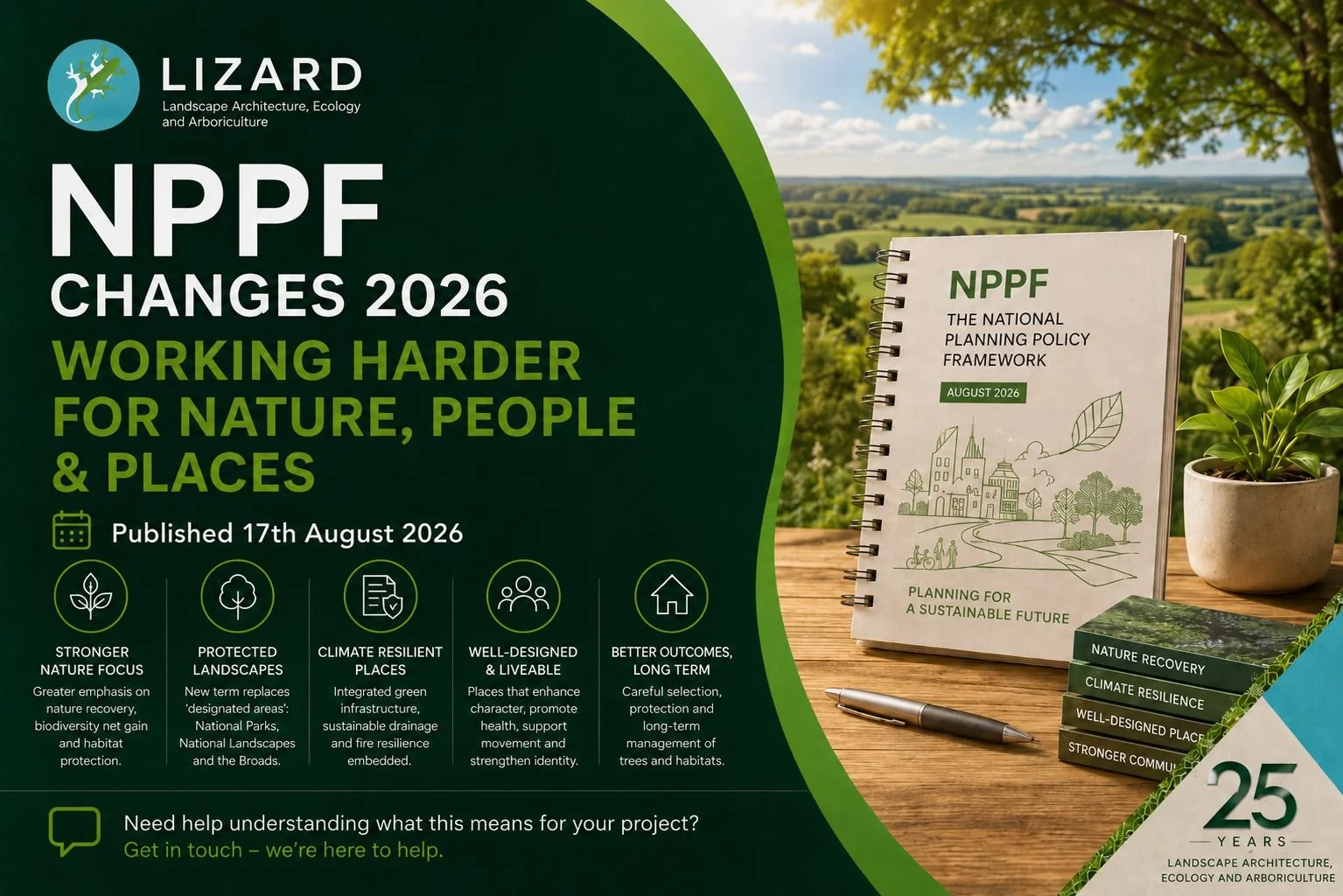
The NPPF has changed and there is plenty for landscape, ecology, and planning professionals to take note of.
The 2026 National Planning Policy Framework brings new structure, but perhaps importantly, it strengthens the emphasis on how green infrastructure, trees, nature recovery, and climate resilience need to be integrated into development.
A few things that caught Lizard's attention:
Green infrastructure is doing more work:
The NPPF places emphasis on multifunctional green infrastructure, supporting biodiversity, recreation, surface water management, climate adaptation and health.
Trees: right tree, right place, right future:
There is a clear push for tree-lined streets, appropriate species selection and, importantly, long-term maintenance of both existing and newly planted trees. Arboricultural input is explicitly encouraged.
Climate resilience and wildfire risk:
Sustainable drainage, tree planting and green infrastructure are highlighted alongside measures to manage overheating and, where relevant, wildfire risk, including the use of firebreaks in planting and development layouts.
Nature recovery is firmly embedded:
Policy N2 calls for development to contribute positively to the natural environment, strengthen ecological networks, protect existing natural features and incorporate measures for priority species such as bats, swifts and hedgehogs.
Design and landscape are increasingly interconnected:
The principles for well-designed places bring together climate, nature, movement, public space, identity and built form, reinforcing the importance of considering landscape as an integral part of development rather than something added at the end.
Protected landscapes:
The terminology has changed from 'designated areas' to 'Protected Landscapes', with a continued strong emphasis on conserving and enhancing their special qualities and natural beauty.
Ancient woodland and irreplaceable habitats:
The updated glossary provides clearer definitions, while the policy position remains very strong: development resulting in the loss or deterioration of irreplaceable habitats should be refused except in wholly exceptional circumstances with appropriate compensation.
One other interesting change for anyone involved in LVA is the reference to 'valued landscapes' having been removed from Chapter 19. That could have some interesting implications for how non-designated landscapes are considered, particularly at appeal.
Overall, the direction of travel seems clear: better places, more nature, more resilient landscapes and much greater emphasis on getting the landscape and ecological thinking right from the outset.
Lizard will be working through the detail and updating its approaches and discipline templates accordingly.
